Showing posts with label Teaching. Show all posts

Saturday, March 15, 2014

Education Takes a Hit in Proposed NASA Budget

Ugh.

Let me just repeat that.

Ugh.

NASA's proposed 2015 budget isn't making many people smile, that's for sure. With cuts to planetary science (let's stop studying climate change, shall we?) and reallocation of funds from missions like Opportunity to cover the costs of missions like Curiosity (while we're at it, let's sacrifice one rover for the sake of the other!), there isn't lot of good news out there.

But to me, the worst news of all is the severe cut in education funds. It's taking a 25% hit. Reducing education by a quarter. Are you kidding me?

Ugh.


NASA's budget video shows a group of curious kids learning how to play with rockets. Look how cute they are! So inspiring! Now let's take away one out of four of those kids. No space education for you! Reducing the number of people who understand space and technology is surely the best way to move our country forward!

Now, that's obviously an oversimplification of the problem, but the fact remains that someone thought it was a good idea to have NASA cut back on teaching people about what they do. That means this burden falls on us science education professionals in non-profit, non-government institutions. We do our best. We really do. But the further you go from separating the science and the scientists from the public, the bigger the gap is going to be in public understanding.

Who are you more likely to listen to? "I am from a science museum, let me tell you about the newest space mission!" or... "I am from freakin' NASA, let me tell you about the newest space mission!"

This isn't to say that us non-profit science institution folks don't know what we're talking about. It's our job to know, and we generally rock at it. But the level of impact changes when it comes from us, as does the level of connectedness.

If you keep laypeople away from scientists, you get problems. This is the same issue that comes from big-wig scientists not knowing how to communicate to the public. This is the same issue that results in people's lack of understanding about evolution and climate change. This is the same issue as to why the U.S. is ranked so low in the general population's understanding of science.

We just don't put real importance on it.

This problem is why I do what I do. It's why I'm a science communicator--to help every day people understand the field of science. But us science educators can't shoulder this burden alone. We're under enough pressure as it is. I've been to schools where I've been told I am their science lesson for the year. A one hour assembly, and that's all the science they're going to get, so I better make it count. No joke.

Cutting education should never, ever be the answer.
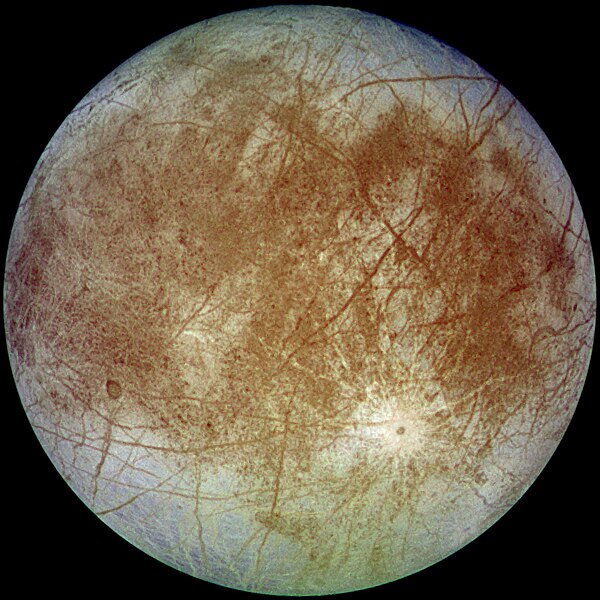
There might be aliens here.

...Ugh.

The one part of this budget plan which doesn't make me cringe is that they're allocating some money to look into a mission to Europa, Jupiter's icy moon. It's long been speculated that under its icy crust, down in its giant oceans, our best bet at finding alien life may lurk. Trying not to be too giddy that this kind of mission might actually happen in my lifetime.

This budget hasn't been approved yet, so more changes may come. We can only hope NASA gets the funding they ask for at the very least, and that more cuts don't need to be made. NASA's only asking for less than half a percent of the entire 2015 budget. Less than half a percent to take our nation into the future. Imagine what we could do with a full 1 percent.

Actually don't. Because you'll just get disappointed that it'll never happen.

Monday, December 17, 2012

A Safe Place to Learn

I think the events of this past Friday have made us all give pause and hug our families tighter. When we do get moving again, which everyone has (or will) at their own pace, it's obvious that all of us are moving with the extra weight of sorrow in our hearts.

I just wanted to make a brief post this morning to say thank you to all the teachers and school personnel across the country who put on their bravest faces and walked back into their schools today.

You are why schools are a safe place to learn. From bandaging schoolyard scrapes to putting stickers on homework to keeping smiles going throughout the day, you're why children feel safe. You're their comfort. And despite your own sorrow and fear, your own crushed heart in the wake of this awful tragedy, you're going to be there for these kids each and every day no matter what. You know that, and they do, too.

I'm not going to address the discussions happening all over the internet and news about gun control, mental illness, etc etc, because honestly, all those proposed safety plans pale in comparison to recognizing and caring for the front line heroes we send our children to each day.

Today, I salute elementary school staff. The people who look after and protect the hearts of kids who are not their own, but who they love like they are. Terror hit on Friday, but you're pushing through that to help others, and nothing is more heroic than that. Thank you. Thank you for giving children a safe place to learn.

Wednesday, March 7, 2012

Science Inspires

Think science is a cold, unfeeling subject, too dry to include in story writing? Or maybe it's just there to be used in stories as a plot device, à la disaster films? Think again.

Science opens up a whole new understanding of the universe around us, and our place in it. The knowledge it brings can awaken some of our deepest emotions. Science can be, and is, incredibly beautiful.


Today, I gave a planetarium presentation for sixth graders and blew their minds (nothing unusual there, it's a common occurrence in my line of totally awesome work).

One girl in particular just couldn't stop asking questions. It was great, especially since when the presentation began, the sixth graders were all completely silent, with no questions for me whatsoever. Who wants to look lame in front of their fellow middle schoolers, after all?

After about thirty minutes of teaching, the atmosphere had completely changed (as it always does). The sixth graders couldn't get enough of astronomy. They wanted to know more and more and more. Especially the one girl I mentioned.

"So wait. What's out there after the end of space?"

"Nothing."

"Nothing?"

"Nothing."

"So like...emptiness?"

"No. Nothing. Nothing is just that: nothing. It's hard for our minds to comprehend."

"So that's it, then? We get to the edge of the universe, and we can't go any further?"

"Not exactly. The universe is expanding, so we'll never really be able to get to the edge. Perhaps we could get close, but the next moment - bam - it will be bigger."

"But after the universe, there is nothing."

"For our universe, yes, that's how it works."

"Our universe?"

"There may be more than one universe. We might be part of a multiverse. One universe, amongst many. And each with their own rules."

"So...what would be in those universes? Other humans? Could we be in another universe right now, just...different?"

...the questions just kept coming. And who could blame her? It's fascinating to think about. And all provided by science.

She's not alone, either. Every kid has these questions, and more.

The point of this post, is to demonstrate that science is a story. It's the story, in many ways. And I've yet to meet a kid who doesn't want to hear it. Or, as they get older, a kid who doesn't want to hear it after I first get them to sit down and listen for a few minutes. The older the kid gets, the bigger the hurdle to jump to convince them that science isn't "lame" (something I will address in future posts).

However, no matter their age, when my teaching time is up for the day, every kid begs for more. They want to hear the whole story. Science has struck a chord deep inside them, and they want to learn everything they can about it.

But that's the wonderful thing about science. The story is never complete. There is always more to learn.

My challenge to all authors is to take advantage of the naturally awe-inspiring stories science provides, and incorporate them into your work. It won't make your story dull, or make it feel like school, or make it too technical or clinical sounding. It will make it awesome.

Now go watch that Neil DeGrasse Tyson video from earlier in the post, if you haven't done so yet. Maybe you'll see what I mean.