Wednesday, May 23, 2012

Part of the Family: Housecats


This is a continuation of my blog series, Part of the Family.

So now that we understand how humans are related to other primates, going all the way back to before the asteroid impact 65 million years ago, it's time to figure out how our pet cats figure into this family equation. Like my best buddy, Galileo:


We adore them, pamper them, and love them. Some of us do all of that while sneezing our faces off. But why? What's so stinkin' cute about a widdle puddy tat?

Well, first off all...ever notice how humans are much more likely to find other mammals cute, rather than say, a bird, or a snake, or a lizard, or a frog? Sure, some of us just find everything adorable, but the average person is going to be way more warm-fuzzied by something that is, well, warm and fuzzy.

And that makes sense. We tend to feel most protective towards creatures that share more of our genes. Why? Because we're programmed to feel that way. By our genes. (Is your mind blown yet?)

We share the vast majority of our genes with the common domestic cat, just as we do with any mammal. But cats (and dogs for that matter) are not the most closely related mammal to primates. Regardless of our personal feelings, as a human, you're more closely related to a rat than you are to your precious Mr. Mittens McFluffytail. Can't pick your relatives, right?*

So if we should feel more protective towards things we're more closely related to, why do most people prefer cats to rats? Obviously, things are much more complicated than simply ranking your favorite creatures by the percentage of DNA you share. Cats have wormed their way into our hearts, beating out our closer rat relatives, by improving the odds of our human relatives' survival (which totally trumps everything else). So good job, cats. You've essentially beaten the system.

Our relationship with cats has slowly developed over time to be one of mutual assistance. They help us keep our food safe from rodents, we in turn protect them from predators and ensure they don't starve.

Cat with kitten amulet, 400 BC
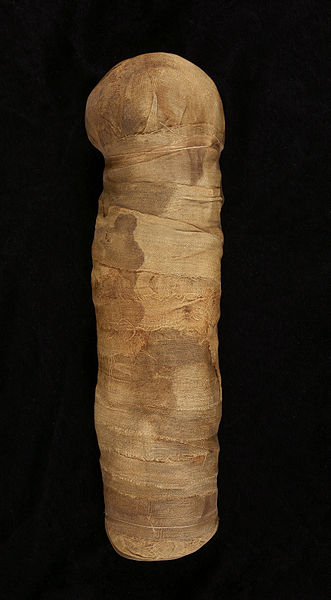
Mummy cat, 400-200 BC
This has been going on for a long time. At the very least, from the time of the ancient Egyptians 3600 years ago, as evident by paintings of house cats, statues of cats in homes, and the mummification of cats as respected, even revered, creatures.

There is evidence that this relationship with cats may predate the ancient Egyptians. In a burial dated to 9500 years ago from Cyprus, a human was found carefully laid to rest with a cat.**

 Whatever the case, we've been hanging with cats for millenia. That's long enough that the cat may have actually influenced the past few thousand years of human evolution. It could be that we've had a slow selection acting on us to favor people who like, or at least tolerate, cats milling about in their lives. They're helpful, after all. It would not surprise me to learn that we have a collection of genes that effectively give us "cat tolerance".

But beyond our current social relationship with cats, what about our genetic one? How to felines actually relate to primates?

Sand cat.
Well, it's time to go backwards through time yet again.


The modern domestic cat is part of the genus Felis, which includes several species of small cats such as the sand cat of northern Africa and the Middle East.
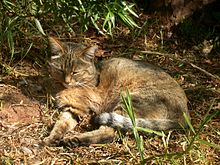

African Wild Cat.
This genus of cats is mostly known for its smaller size and its affinity for hunting rodents. They split off from the rest of the cat family around 10-8 million years ago, according to genetic studies. The African Wild Cat is likely the particular member of this genus that gave rise to our own fluffy household kitty cats.

Before 10 million years ago, these cats would've been part of a larger group called the subfamily Felinae, which again, is mostly small cats, but does include the ancestors to the cheetah and the cougar. So if you've ever wondered which big wild cats your pet is most closely related to, there you go.

Creepy thought of the day: the Cheshire Cat must eat meat to survive.
All members of the Felinae subfamily are part of a much bigger family known as the Felidae, or simply, the cats. The cats branched away to do their own thing around 25 million years ago. So what sets them apart from other animals? Retractable claws. Five toes on their front paws, four on their back. Their characteristic "sandpaper" tongue, used to rasp meat off bone. Fewer teeth than other carnivores. Being carnivores. And not just regular carnivores, but obligate carnivores. That means they must eat meat to survive, and very little (if any) of their diet is based off of non-animal material. They are the most carnivorous of any land carnivore. So it may not come as a surprise to learn that they're part of a bigger animal order called Carnivora.

Carnivora is an order that's broken up into two suborders, the feliforms and the caniforms. Guess which one your cat is from? Yep, the suborder Feliformia. Guess which one dogs are from? Duh, Caniformia. Now guess which one those nasty Lion King hyenas were from?

Feliformia. Yep. Hyenas are more closely related to cats than to dogs.

Anyhow, the two suborders split around 42 million years ago. One major distinguisher between the two is how their auditory bulla (or ear bone covering) is formed. Feliforms have a double-chambered one, caniforms have a single-chambered one. Might not sound fascinating, but its these sorts of differences that are key for paleontologists, who work with bones. Other differences include the behavior of feliforms to be more ambush-y in their hunting strategy than caniforms, but that's a lot harder to tell from the bones.

Sadly, another difference is that feliforms are usually more forest-based, so that means we have a terrible fossil record for them. Bones degrade quickly in forest environments are rarely have time to fossilize.

So onwards (or backwards) to the next big split: the Carnivora from the rest of the Eutherians (non-marsupial mammals). This is finally where we'll see what drove apart cats from humans!

There is no such thing as a saber-toothed tiger.
Carnassials!
Carnivorans are characterized by a pair of humungous gnashy-gnashy meat-destroying teeth on each side of their jaw, known as their carnassials. Carnassials are not to be confused with saber-teeth, which did show up in some Carnivores, like the saber-toothed cat, Smilodon. Carnassial teeth are farther back and meant for ripping meat and crushing bone open for marrow, and not so much for the actual killing of prey.

So now we're almost to the point where our cats lineage joins up with our own. Carnivora branched off before 65 million years ago. But even earlier in time that, there is one last branching event to talk about. The branch that separated one major group of mammals from another, long before the infamous asteroid struck Earth and cleared the way for mammals to take over.

On one side of this branch are the carnivores, the camels, pigs, goats, giraffes, the whales, the horses and the rhinos, the shrews, and the hedgehogs, among many others.

The other side includes the rabbits, the rodents, and the primates. In other words, us.

Major split. And probably happened over 90 million years ago. The only physical characteristics that tell these groups apart may be some features of the skull around the ear. The split itself was probably just an element of location. The group the cats belonged to came from the supercontinent, Laurasia, while our group seemed to originate from islands off the coast of this supercontinent.

So some 90-odd million years ago, the last common ancestor of cats and humans had one of its members swept up and out to sea to land on some islands near the coastline. Our last common ancestor would've looked quite a bit different from either of us, but would've had a few recognizable features. It would've had hair on its body. It would've had teeth that came in the form of molars, premolars, canines, and incisors. And it would've given birth to live young, attached via a placenta, which it then would have nursed with milk.


Above is an artist rendition of Eomaia, 125 million years-old, and one of the early ancestors of humans and cats alike. Maybe she doesn't look like much, but she gave rise to a really cool batch of animals.

Now, maybe you're saying to yourself...wow. This was a lot to read. It sure took a while to get to the point back in time where humans and cats really were one and the same. We're not that closely related, after all!

If that is indeed what you're thinking...just wait until you see how we're related to the ground up coffee beans used in your morning latte.


* I adore rats, for the record. And they will be the focus of a future "Part of the Family" blog post.

** I am not an archaeologist, and do not know if this discovery is controversial within the field or generally accepted as an actual indication of early cat domestication. If anyone more informed does know, please chime in!


Citations:

Benton MJ. 2005. Vertebrate Paleontology: Third Edition. Malden, Massachusetts: Blackwell Publishing Ltd.

Johnson W.E., Eizirik E., Pecon-Slattery J., Murphy W.J., Antunes A., Teeling E. & O'Brien S.J. 2006. The Late Miocene radiation of modern Felidae: A genetic assessment. Science 311: 73–77.

Pecon-Slattery J. and O'Brien S.J. 1998. Patterns of Y and X chromosome DNA sequence divergence during the Felidae radiation. Genetics 148: 1245–1255. 

Prothero DR. 2004. Bringing Fossils to Life: An Introduction to Paleobiology: Second Edition. New York, NY: McGraw-Hill.

Thursday, May 17, 2012

Blog Series: Part of the Family

Here's something I've been wanting to do for a while. It's time to explain to the interwebs how I see the world. This will be the introduction to a series of posts discussing why I consider everything on Earth to be part of my family.

Starting with this guy:


Yes, that is my cat. His name is Galileo. And he's four years-old.

He's also part of my family.

Now...many people say that about their pets. And they mean that they love them as if they were actually a "related" person.

But your pets are related to you. Everything is. In this post series, I will aim to expand minds to see what exactly our relationship is with everything around us. We're all part of a tremendously huge story. Characters in an ongoing saga, if you will. An ongoing saga of awesome.

In order to understand how we're connected to everything else, it's critical that we start out with an understanding of the last 55-80ish million years of human evolution. This will allow us to see how humans connect with the rest of the mammal world.

A rough idea of evolution over the past 2 million years. 
Humans as Homo sapiens have been around for oh, about 200,000 years now. Just a sliver of time when you consider the over 14 billion year history of our universe.

Instead of a giant prehistory lesson, I'll skip over many of the various species names involved in human evolution (since many of the designations are hotly debated anyway) and just discuss the broad changes that occurred. If you're really curious, I've included a basic visual for the past 2 million years. (For those counting, I said we're going to cover nearly 80 million years of evolution. Just keep that in mind.)

Modern humans came about as a change of brain structure, mostly. Going backwards, the genus Homo as a whole came about from some brain restructuring, but honestly mostly just from our ancestors getting longer legs. This was just over 2 million years ago.

Who's that good lookin' gal?
Before that, we were shorter and had more body hair and smaller brains. This was the time of the australopithecines. If we saw an australopithecine today, we'd probably be more tempted to call it a weird-looking chimpanzee. Why? Because they are much closer to the common ancestor of humans and chimps than we are!

We split from the line to chimpanzees around 6-7 million years ago. Roughly. At the split, human ancestors adopted more of a bipedal locomotion style, while chimpanzee ancestors either retained or developed a knuckle-walking locomotion style. This was probably due to filling in different environmental niches. This whole period of time is still pretty fuzzy, though. We used to think human ancestors evolved for life in the grasslands, but that's probably not the full reality.

In any case, it's important to remember that WE DID NOT EVOLVE FROM CHIMPANZEES. That'd be like saying your cousin gave birth to you. No. That's not how it works. We share a common ancestor with chimpanzees, but chimpanzees have been evolving away from that common ancestor just as much as we humans have been!

Swinging along like a champ. Ape pride!
Now before our split with chimpanzees, we were part of a species that went on to produce us, chimps, and gorillas. The African Ape gang. But if you keep going back in time, our ancestral species 14 million years ago also branched off to produce orangutans. And before that, 18 million years ago our ancestors split off a branch that went on to produce gibbons.

But before 20 million years ago, things get fuzzy again. We know from genetic testing that apes and monkeys (that's right folks, apes are NOT monkeys) split around 30 million years ago, but the fossil record kind of stinks for a while here. We don't know exactly what we looked like during this time, but we do know what makes apes distinct from monkeys. The loss of the tail, for instance. Extra mobility in the limbs (monkeys, for the most part, can't do monkey bars, while humans, being apes, rock the socks off monkey bars). All of that came about during this time frame, from around 34-18 million years ago.

But before that, we were one and the same with the monkeys. We were not monkeys, just as we were never chimps. We were part of a group that included the ancestors of modern monkeys and apes called haplorhines. (For the nerdy among us wondering, I'm skipping over the division of catarrhines from platyrrhines 40 million years ago and going directly to our common ancestor for all monkeys and apes. Because talking about losing an premolar in the dental formula is just not that fascinating to the average person.)

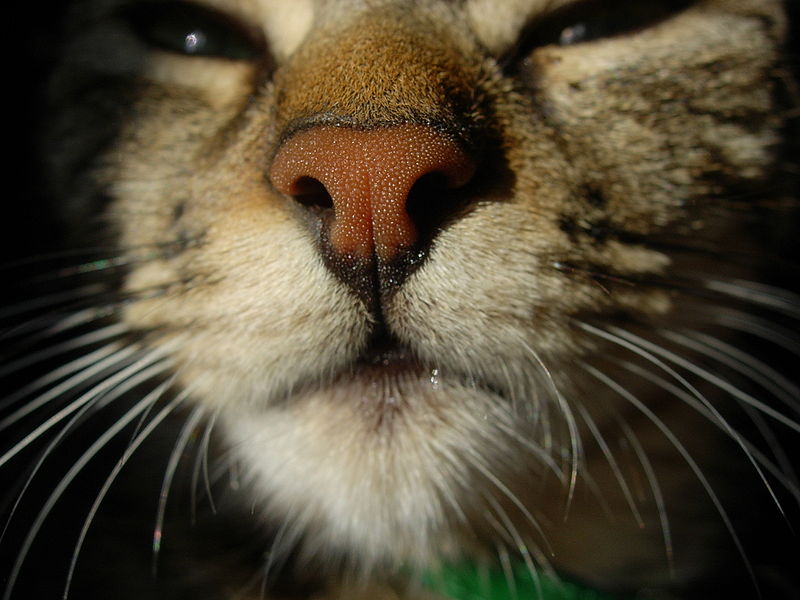
A kitty cat's split lip.
Haplorhines split from a group called strepsirrhines (which include lemurs, lorises, and galagos) between 60-65 million years ago. Haplorhines are the "dry nosed primates". That means our nose doesn't have that split down to the lip that many other mammals have. Strepsirrhines keep that split. Their mouth and nose looks much more like that of a housecat.


Smilodectes, roughly 50 mya.
Now, the ancestor of all primates, haplorhines (monkeys, apes, tarsiers) and strepsirrhines (lemurs, lorises, pottos, galagos) alike, may have already been around as early as 85 million years ago, according to some recent molecular clock data. Even if it wasn't 85 million years, it had to be before 65 million years ago, based on genetic evidence. So for those doing the mental calculation...primates split from the rest of mammals a long, long time ago. And yes, primates survived the asteroid impact 65 million years ago.

Unfortunately, the fossil record for primates before 58 million years ago is poor, so it's hard to say exactly when our first primate-y features showed up, or even what they were. But from the record we do have, it seems the earliest true primates had an increased reliance on vision, and greater finger/toe dexterity with opposable big toes or thumbs. The rest...well, paleontologists are still trying to figure out the rest.

So there you have it. That's us. All the way back to our split with the rest of Mammalia.

Which means we can now trace our relationship to other mammals...like my kitty cat, Galileo. But that will be for a future post. This post was just an introduction to the amazing story that connects us all. We'll need to dive deeper to see how we're related to everything else around us.


Citations:

Chatterjee HJ, Ho SYW, Barnes I, Groves C. 2009. Estimating the phylogeny and divergence times of primates using a supermatrix approach. BMC Evolutionary Biology 9: 259.

Fleagle JG. 1999. Primate Adaptation and Evolution: Second Edition. San Diego, California: Elsevier. 

Ward CV, Begun DR, Rose MD. 1997. Function, Phylogeny, and Fossils: Miocene Hominoid Evolution and Adaptations. New York: Plenum Press. New York: Plenum Press. p 1-12.


Tuesday, May 8, 2012

RIP Maurice Sendak

“And [he] sailed back over a year
and in and out of weeks
and through a day
and into the night of his very own room
where he found his supper waiting for him
and it was still hot” 

Tuesday, April 24, 2012

One story ends, and another begins...

The U.S. space shuttle program is over. The shuttles are being moved to their new homes. Discovery, the most recent shuttle to be moved, was flown piggyback style from Kennedy Space Center to the Smithsonian last week. (Sad, but also...friggin' awesome. I mean, look at that picture!)

Anyhow. Retiring the shuttles has stirred up loads of controversy. Mostly regarding the lack of plans for any immediate replacement.

I am all for the retirement of these vehicles. They're dangerous and old. Do I wish we had new ones ready to take their place? Of course. But we don't.

A rant on that deserves its own post, so I'll leave that thought for now. While it is important to acknowledge the end of this great space story, it's equally important to highlight the start of a new one:

THERE IS A FREAKING AMAZING PLAN TO START MINING ASTEROIDS. FOR REALSIES.

Planetary Resources is a company consisting of loads of ex-NASA folks and backed by X-Prize billionaire founders, Google execs, and James Cameron (who just got back from visiting the deepest part of the ocean). And they are going to make asteroid mining a reality.

...someday.

Okay, so they aren't mining asteroids just yet. But they do have the groundwork laid. Their first step is to send up small space telescopes to locate and examine asteroids around us. Next, they'll tap for non-precious materials in the space rocks, like water, which will be critical as a resource out in space for both these asteroid missions, and pretty much any other mission. They'll make reservoirs of such resources to float around out there for others to use (at a price, I'm sure). Finally, the third step is the actual asteroid mining.

The cool part about this is that their goal isn't just to make loads of money by mining precious metals, etc, but rather to lead the way into further space exploration. Odds are, money won't start coming in from these operations for decades to come. So they really aren't out to get rich quick, here. These are people who are genuine visionaries and are doing this just to see if it can be done.

And it can be. Visit Phil Plait's blog (Bad Astronomy) if you want a more in-depth and professional explanation of what's going on. This isn't impossible. It can be done.

Will it be done?

I don't have an answer to that.

It's exactly like writing a novel. You start out with a great idea. You might even put together a solid plan. But as you begin, you find obstacles. You are forced to make changes. New ideas pop up halfway into things. And your end result might not be what you'd been originally planning at all. Or maybe it will be. Or maybe there will be no end result, because you fizzle out and lose interest.

Any and all of that is possible with this new endeavor that Planetary Resources is embarking upon. But regardless of where it goes, this is the start of a new space story. We're not done with you, Outer Space. Even as we pack away our shuttles, humans still have their eyes trained up at the stars.

And that makes me ridiculously happy.

Post-Conference: NESCBWI 2012

Wow, what a conference!

I got back from Springfield on Sunday evening and was far too wired from my post-conference high to sit down in front of my computer and write a follow-up. And yesterday I was naturally far too exhausted to do so.

Two days late, here I finally am. I'll be keeping this short, because I have another post I intend to write tonight. So, here is a brief list of takeaway lessons I learned from the conference:

  1. Publishing will happen when the time is right. There is no rush. Rushing just hinders your own growth as a writer.

  2. It pays to take the time to get to know the business and marketing side of the writing world before you actually land yourself a book deal. As Scar once famously said, "Be prepared!".

  3. In my newest project, my kid character team apparently meets secretly in a old musty cellar that I didn't even know existed before Saturday. Thanks, writing prompts!

  4. Real-life writing friends are the best things ever. My critique group kicks butt and takes names. We're going places, baby, and we're having an awesome time together on our journeys.

  5. I'm ready to query. Really, truly ready. I had my query letter and first ten pages critiqued, and the agent and editor who did the critiquing found next to nothing wrong with them! A few touch-ups, and then full-steam ahead to the agent hunt! Huzzah!
All in all, a fabulous weekend. I'm already looking forward to next year. And in the meantime, I'm looking forward to reading the awesome new books I bought at the conference bookstore.

Thursday, April 19, 2012

Pre-Conference: NESCBWI 2012

Here we go!

This will be my second year attending the annual NESCBWI conference, and I'm totally pumped. Especially for this year's theme: Keepin' It Real. (Dropped "g"/apostrophe addition mine. Just looks cooler that way.)

Reality is awesome, and it's great that it's getting attention this year. I mean, reality is where SCIENCE happens, so how can I not love it?


My goals for this year's conference:

1. To get over my fear of writing non-fiction and get comfortable with the idea that in my writing career, I can be both a fiction and non-fiction author. (Everyone under the sun wants me to write non-fiction, and the idea currently terrifies me.)

2. To learn more about the agent-author relationship and the road to publishing. (A road I hope to be on soon.)

3. To get solid critiques of both my query letter and first ten pages, so I can re-enter the agent hunt with more confidence. (I purposefully put querying on hiatus as the conference has grown closer. I'm eager to jump back into the waters.)

4. To get inspiration for my current project. (More than anything, I want the fantastical premise of my newest story to feel like it's firmly grounded in reality.)

5. Have a lot of silly fun with my fabulous SCBWI critique group. (Who's bringing the hummus?)

If last year is anything to go by, I'm positive all these goals will be reached. NESCBWI 2011 was amazingly helpful and gave me tons to think about. For NESCBWI 2012, I signed up for sessions that I believe both build upon last year's lessons and are also relevant to my current level of author "maturity". I want to make the most out of this weekend.

So here we go!

Thursday, April 12, 2012

Alien Animals

With science discovering new exoplanets nearly every day now, proving that our solar system is not all that special (and most definitely not alone), it's a super fun time to write sci-fi!

Finally, there is science to back up the idea of planets around other stars, planets within a habitable range of stars (the "Goldilocks Zone": not too hot, not too cold), and even methods for detecting the composition of the atmospheres of these planets (...water vapor? Oxygen? We're lookin' for YOU!). At this point in time, it's pretty much assumed that aliens must be out there.

Awesome!

...but wait. Before you grab that pen and start creating your alien planet, now may be a good time to step back and learn something about evolution.

I think most of us grasp the basic concepts of evolution: species change over time, and it usually has something to do with out-competing each other and/or fitting into their environment. But if you're going to sit down and construct an entire alien world, you need more than the basics.

Example: James Cameron's Avatar attempted to create an alien world with fully fleshed out ecosystems. I say "attempted" because, in my opinion, they failed.

Setting aside whatever positive or negative feelings I have about the story itself, the glaring issues with the created creatures made it hard for me to concentrate on the movie. The sad thing was, I could see that a great deal of thought had gone into the invention of these animals. Clearly, though, not many thoughts from functional morphologists.

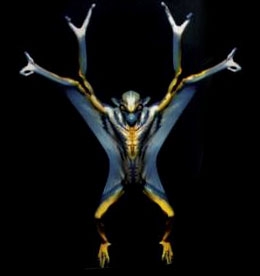
Instead of a detailed rant covering each and every one of the flaws I noticed, I'll focus on the biggest one. And no, it's not the tail-mind-meld thing, which I just have to chalk up to movie magic so I don't hurt my brain. No, my personal biggest issue is the number of limbs Pandoran animals have:

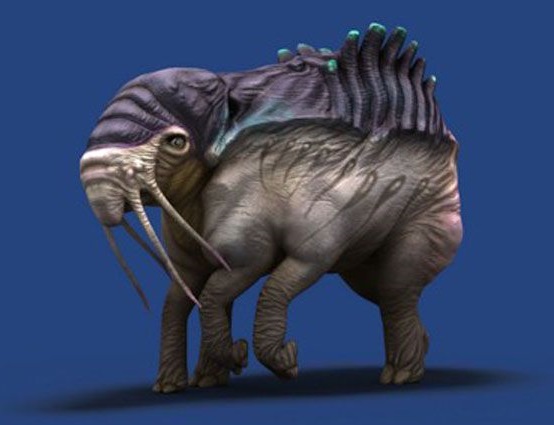
Six, for the most part.

Frankly, that's alright with me. It makes me curious as to their skeletal structure, but it doesn't raise any improbability flags. At least, not until we examine where the exceptions are:

The Na'vi only have four limbs. 

Four.

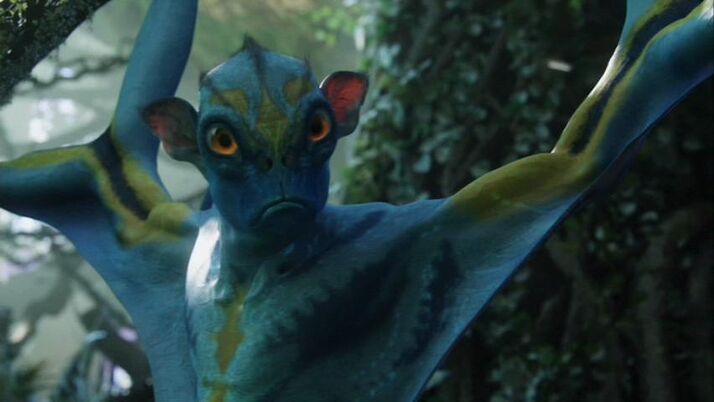
The movie attempts a cutesy way of explaining this. Fairly early on in the movie, this guy shows up:


Some sort of primate-like critter, hanging out in the trees. Instead of six distinct limbs, this guy has two hind limbs, and its two pairs of front limbs appear to be fused.


I see what you did there, Avatar. Giving a nod to our own evolution: humans are primates, and the Na'vi must be from whatever family this guy is from. So this guy has fused forelimbs as sort of a evolutionary step towards only four limbs.

Too bad this is just plain silly.

Tree-dwelling animals would not fuse limbs together. Tree-dwelling animals evolve to hold on well to branches, and the more limbs for that, the better. Reducing the number of limbs is absolutely backwards from what happens in reality. Six limbs would be an amazing advantage in the trees. Heck, just look at spider monkeys. They use their tail as a fifth "limb" because extra limbs are just that awesome in trees.

Unless those lemur-like fusing limb aliens evolved from a creature who had been a ground-dweller, it just makes no sense for selection to favor fused limbs in the trees. The Na'vi themselves, as a primarily tree-dwelling species, should've retained six limbs as well. But they didn't.

The Na'vi must have left the trees sometime in their evolutionary past for the limb proportions they have in the movie (human-like limb proportions) to make any sense. They obviously switched over to bipedalism as an adaptation to living on the ground rather than up trees, and lost their extra set of limbs because...

Okay, I still can't explain why they'd completely lose their extra set of limbs. I mean...EXTRA PAIR OF HANDS. SO USEFUL. WHY DID THAT DISAPPEAR?

Ahem. Anyway. Continuing with my confusion, while the tree-dwelling animals are, for who knows why, reducing their flexibility and number of limbs, it appears the ground-dwelling animals hold onto their extra limbs.

Excuse me while I go flail about in frustration.

Animals that specialize in running along the ground are known as cursorial animals, and evolutionarily-speaking, cursorial animals evolve to reduce how much their limbs come in contact with the ground (think horses as an example: they reduced even the number of toes that touch the ground down to one toe per leg). Therefore, if any animal on Pandora should fuse limbs...it would be these ground-dwelling ones. But in every instance of a ground-dwelling critter on Pandora, it of course has six limbs.

So maybe none of them are actually cursorial? They don't run?

Except for all those scenes with stampeding animals in the movie. Oh dear.

Frankly, the Na'vi are the only potential ground-dwelling animal for whom it would make sense to keep all six limbs, since they only use two limbs to touch the ground anyway. But they're the only ones who lost a set!

Perhaps now you begin to understand my issue with this movie. This is just one example of where the body structure of Pandoran animals fails to make sense. As mentioned, I won't go into all the other instances here. It would take far too long.


Takeaway lesson:

If you're going to create an alien world, do yourself a favor and read up on evolution, and in particular, functional morphology. Functional morphology is the study of how the structure of a body part relates to its function. It answers the question, "Why does that thing look like that?".

If you want cool things that may not make sense on your alien animals, read up on sexual selection as well. Animals can certainly have things on them that don't serve much of a purpose for their own survival, as long as it somehow relates to the survival of their genetics (getting the opportunity to pass their genes on through mating). This gives the chance for a lot of creativity on your end as an author.

Whatever you do, though, don't fall into the trap that advanced species must resemble us. The Na'vi could've had extra hands! So cool! But as biased human creators, they were designed instead to match our own bodies. Perhaps to make it easier on the human characters who had to take on the alien forms. Perhaps to make it easier on animators. Or, most likely, because we associate our own form with higher intelligence.

Just some food for thought as we begin to imagine what could be alive on all these new planets science keeps finding. Aliens are awesome in stories, but they're even cooler when they're biologically plausible.