Showing posts with label Physics. Show all posts

Friday, December 30, 2016

Yearly Science Roundup: 2016

It's that time again. Time to look back at the year and sum up what amazing science happened!

These are my personal five picks for the top science stories of 2016. Three of them are space-related, which is only fitting with my space-themed debut novel coming out next year. Feel free to chime in down in the comment section with your own top picks, if they aren't on this list.

Anyhow, without further ado, here we go!

5. Proxima b

Image by ESO/M. Kornmesser

This past August, the European Southern Observatory reported the discovery of an Earth-like planet orbiting the star nearest to our own. Finding new exoplanets isn't as surprising as it used to be, but it's still super exciting to find one this close to our own place in space!

This planet orbits Proxima Centauri, a star only 4 light-years away. It is in the habitable zone, meaning it could have liquid water on its surface and temperatures within the range of our own here on Earth. It is 1.3 times the size of our planet, and probably rocky. To get there with modern technology would still take us 70,000 years, but folks are already planning ways to do it faster!


4. A Sappy Dino Tail

Credit: R.C. McKellar, Royal Saskatchewan Museum

This wouldn't be a Top 5 list from me without something prehistoric on it. It was hard choosing which paleontology story I was most excited about in 2016, but in the end, I had to go with the dinosaur tail stuck in freaking amber.

This amazing find came from Myanmar, and dates back to 99 million years ago. CT scans of the tail inform its classification as a dinosaur, but the type of feathers suggest it likely was not capable of flight. Also lodged in the amber with the tail was an ant, who unlike the dinosaur, didn't get away.


3. We Have LIFTOFF LANDING!


In a moment I'll never forget, on April 8th, SpaceX successfully landed its reusable Falcon 9 rocket booster on a drone barge in the middle of the Atlantic after launching it from Florida. This is a stunning example of engineering at its finest.

I'm so excited about this, you guys. The destruction of rockets during launch has been an expensive barrier for many missions. If the boosters can be reused, this opens the doors to an easier, more economical future for space travel! What an accomplishment.

(Oh, and also, it just looks really cool to see a rocket land on a flat boat in the middle of the ocean.)


2. Gravitational Waves are Real

Aerial shot of LIGO

In what is topping the list for many other sites, I have decided that this discovery will be my 2nd choice for Top Story of the Year. But it is really freaking awesome, so don't think I don't love it.

Decades ago, Einstein predicted this discovery. The concept is that when two massive objects accelerate around one another, such as during the merger of two black holes, it will cause gravitational ripples in the universe, like a stone dropped in a pond. These ripples will actually expand and compress spacetime itself. But how to test it?

Well, LIGO (the Laser Interferometer Gravitational-Wave Observatory) had the answer. Have two lasers in equal-lengthed tunnels aimed at a 90 degree angle from one another. Measure them carefully. And wait.

This year, LIGO observed that one tunnel's laser measured a different distance than the other's for a moment in time. One laser registered as shortening, while the other as lengthening. This compression and extension indicated that spacetime was distorted during the measurements. (And this has been replicated!) Gravitational waves have passed through! They're real, and Einstein was right...again!

This has been a discovery 50 years in the making. So why isn't it my #1? Well, let's get to it and find out.


1. The Antarctic Ozone Hole is Healing

Image credit: NASA

My top science story for 2016 is one of hope, in a time when we really, really need it.

The Antarctic Ozone Hole, which forms every year in the spring when a chemical reaction occurs in the atmosphere, is finally getting smaller. This comes nearly 30 years after an international treaty was signed to reduce the use of ozone-destroying compounds in industry.

As a kid, this was the biggest environmental crisis of the time. Years before I learned about global warming, my worries were focused on the hole in our ozone. It seemed impossible to fix it. All we could try to do, from my childhood understanding, was not make it any worse. Even that, however, sounded farfetched.

But we are fixing it. We're doing it! Intense public outreach about this issue, and some serious worldwide cooperation, is to thank for this environmental disaster being reversed. I had to make this my number one story, because it is proof that we can work together to change how we do things and save our planet from catastrophe.

Let's push forward, and fight for similar changes on other environmental fronts in 2017 and beyond. This should be a lesson to all of us, and a beacon of hope. We're succeeding with one major fight. We can succeed with others!

Let's do this, 2017!

Thursday, June 12, 2014

Spring Catch-Up: Science Roundup

It's no secret that my Weekly Science Roundups fell by the wayside with the rest of my blogging. As I continue to play catch-up on all the events of Spring 2014, I absolutely did not want to miss out on the science! So here's four of the coolest science stories from the past two months.


1. Kepler Mission Extended (and Revised)

NASA

Last year the exoplanet-hunting telescope, Kepler, was forced into retirement by a busted wheel in it housing. However, most of its equipment was still functional and NASA deemed it a waste to just let it all drift out there doing nothing.

Thus "K2" was born. A new mission for a repurposed telescope. K2 will still be on the hunt for exoplanets, but will do so from only one plane of observation, rather than being able to move between planes. It's basically missing an axis to move along because of that broken wheel. Regardless, it's still one of the best pieces of technology ever sent into space, and I'm positive it will continue to advance science even with this handicap.

Go, K2, Go!


2. Teenager's 12,000 Year-Old Skeleton Sheds Light on American Ancestry

NOAA

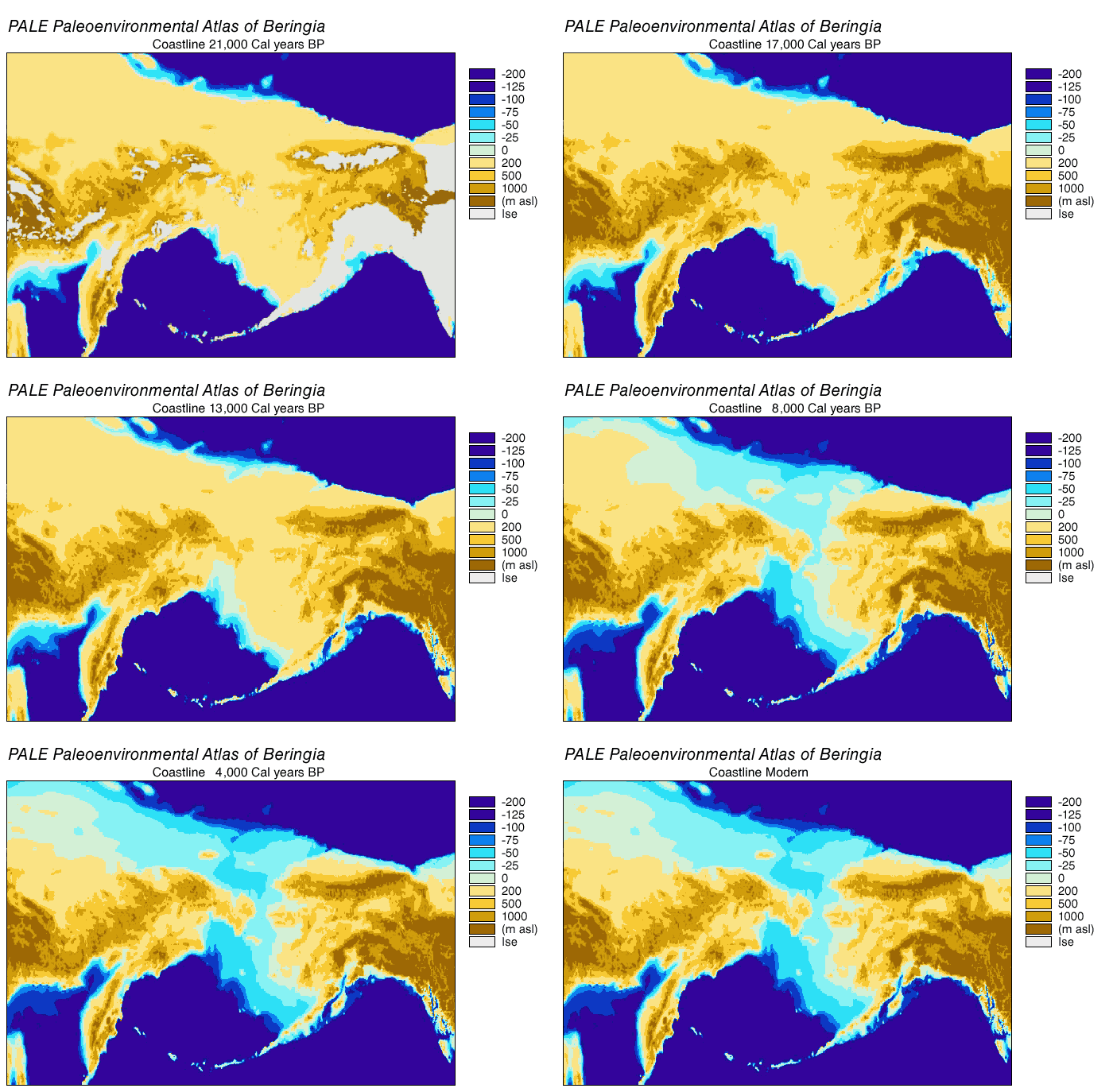
Ancient Americans--or "Paleoamericans"--crossed the Bering Land Bridge between Asia and North America around 20,000 years ago. Despite Paleoamericans and modern Native Americans physically appearing less alike than one might logically guess, a new find has shown that they are genetically very similar.

The discovery is of a 15 year-old female skeleton, dating back over 12,000 years, found in Mexico. She shares a genetic haplotype with modern Native Americans that is found in no other ancient lineage.

What this means is that there wasn't a second (at least, a second major) migration that brought in the ancestors of Native Americans--their populations are almost certainly descended from these original Paleoamerican cultures. The differences in physical appearances is likely just an artifact of deep time.

This, by the way, is the second major genetic study this year to link these populations.


3. Quantum Teleportation a Reality?
Subatomic structure of a neutron.

Quantum teleportation. Just say those two words out loud for a moment. Congratulations. You officially sound awesome.

But what the heck did you just actually say? Well, turns out what you said is actually something real.

The idea behind it is that we are all made of atoms arranged in particular ways, and inside the atoms are subatomic particles arranged in particular ways. As such, if we just make some particles over there arranged in the exact same way, we have achieved teleportation. And thanks to the idea of entanglement, where "entangled" particles can influence each other from far away, distances can be overcome easily. So to speak.

Just a fun thought experiment? Nope. Again, this is real. They've done it. They actually teleported a small amount of information ten whole feet.

It's a baby step, to be sure, but theoretically this could grow to be much, much more. One end result may be Quantum Computing--an internet-esque network of machines that could someday make today's networks look like molasses.


4. Evidence for Explosive Moon Formation Theory

NASA

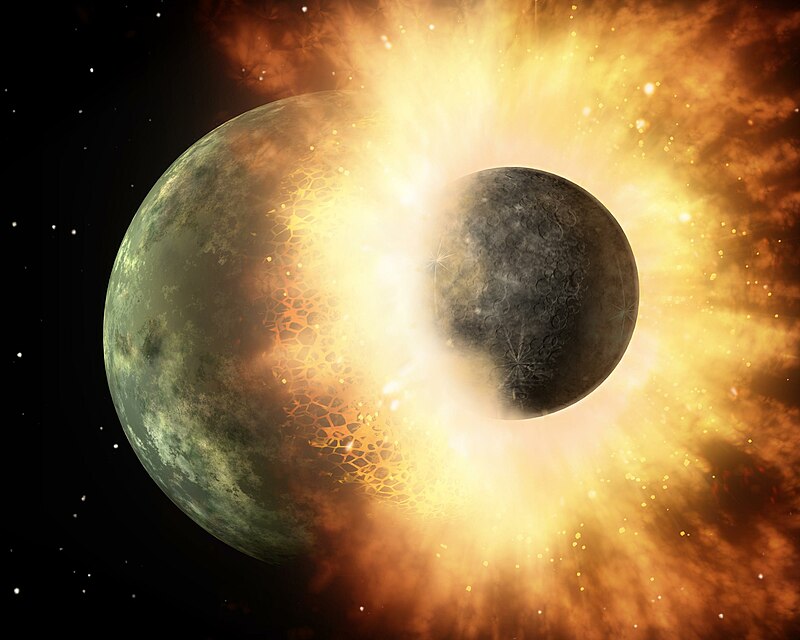
So the story goes like this: Over 4 billion years ago, Earth was slammed into by an object the size of Mars. We call this planet-y thing "Theia". Our moon formed from parts of Earth and parts of Theia. (Gravity + time + lots of mass = round things)

Now there's finally proof that story actually happened. A chemical analysis of moon rocks has detected a different kind of oxygen isotope than is found on Earth, indicating an external source.

This shows that the moon wasn't just formed from the same exact cloud of dust and spacerock that Earth came from. 30-50% of it was from something else. It's concrete evidence that another major body was at play in the moon's formation.

Theia was really out there once.

I love when awesome hypotheses get shown to be right.


Wednesday, July 4, 2012

HIGGS BOSON (most likely) FOUND

They've made the announcement. It appears that the elusive Higgs boson particle has finally been found (OH MY GOD THIS IS AWESOME NEWS).

This is critical. This is a particle that physicists knew must exist, but no one could seem to actual observe it in any way.

Thanks to the Large Hadron Collider and a dedicated team of scientists working for years on this project, they can say with pretty much 100% certainty that they've found what they've been looking for. But what exactly is that? What is a boson, anyway?

To my understanding, bosons are particles that essentially account for all the forces we know, by interacting with each other and other particles, known as fermions. In the case of the Higgs boson, it can be thought of as the reason other particles have mass. That's a pretty important role to play in the universe, so it's obvious why the physicists on the hunt were so driven to find this particle.

Its existence was predicted nearly 50 years ago, and in that time many other particles of the "Standard Model" have been found and confirmed. The Higgs boson, however, held out. This was ridiculously frustrating, because the Standard Model depended on it (see image above).

So how do they know they found it? Well, by smashing protons together in the Large Hadron Collider, scientists observed what particles popped around after each collision, and did their best to measure them. And two teams, working independently to do such tests, have recently found a particle around 125 gigaelectronvolts in weight...which is just about exactly what the Higgs boson was predicted to weigh, and nothing else. Holy cow. SO COOL.

Major congratulations to all teams involved in this epic discovery. This is a monumental day for physics, and therefore a monumental day for everything in existence.

Perhaps my physics friend Andy would care to weigh in on this discovery in a future post, and his take on how this sneaky particle finally managed to be revealed...